
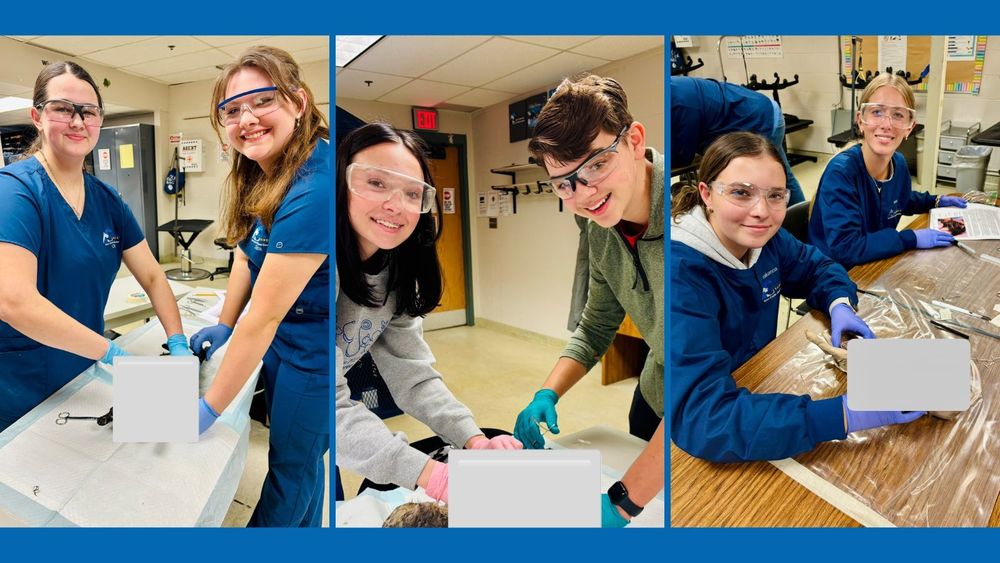
New Castle Career Center Veterinary Science Instructor Zoe Williams understands that hands-on learning is the best way to prepare students for their future careers in veterinary medicine. To accomplish this, Williams created two foundational labs for her students.
Students first have a fetal pig dissection, followed by a cat dissection. The primary objective in these labs is to further student understanding of basic anatomy and physiology in small companion animals.
“Knowing your anatomy and physiology is huge in the veterinary field. Since we work with so many different species, it can be difficult to keep them all straight; however, hands-on learning always helps to further understanding with my students. Reading about something and actually seeing it with your own two eyes (potentially even holding it) are very different things.” Williams explained. “A lot of our mammals have very similar anatomy and physiology, so looking at one species will actually teach the students about multiple species.”
Last semester, students learned the basics of several species, including cats, dogs, horses, and pigs. After learning basic biology and how to care for the animals, they progressed into their anatomy and physiology unit. The dissection labs help students with organ identification, scalpel handling, muscle identification, and biohazard care.
First-year student Alexah Whitehead had some initial reservations about the labs. “I was nervous and scared because I never thought about dissecting a cat, but now I am excited to learn about and see the insides of a cat in person, versus just on a screen. I feel better and more ready now after having dissected the pig already.”
Second-year student Clara Mingle recalls last year’s lab: “When my group dissected our cat, we actually found roundworms, which is a parasitic disease, in the intestines of our cat. Finding the worms in the digestive tract led me to wonder more about how disease travels and really affects each part of the body, so maybe one day you’ll see me practicing pathology!”
Williams plans the dissection schedule so the organs/structures that students find each day follow one another. This helps students understand the route food, blood, and other nutrients take throughout the animal's body.
“I see more of that ‘lightbulb' moment when they remove the heart/lungs, brains, and intestines. With the heart, they are always so amazed to see the large arteries, and occasionally they are even able to manually inflate the lungs if they have removed them carefully enough,” Williams noted. “The brain is always exciting because it's one of those structures that looks exactly like they thought it would. With the intestines, they will cut them open and most of the time find digested food.”
The students are excited to continue building on what they’ve learned.
“When you learn about anatomy, you know that all of the organs are in the body in these approximate 2-dimensional locations. Dissecting allowed me to see in a 3-D setting where exactly each organ and each muscle was located and how all of the body systems connected,” shared Mingle.
Whitehead summarized the benefit this way: “Dissection is very helpful to understand the anatomy versus just seeing it on a slideshow.”
For more information about the Veterinary Science program and the other New Castle Career Center programs, visit nccareercenter.org.